Research at the museum
Research and new knowledge are fundamental to the work of the Swedish Holocaust Museum in interpreting and communicating knowledge about the Holocaustx, its historical context and its significance in contemporary society. Drawing on current research, the Museum explores and critically examines the history of the Holocaust, its consequences and lasting impact, as well as how the Holocaust is remembered and the role that memory plays in society today. Research also informs the development of the Museum’s exhibitions, public programmes and educational activities.
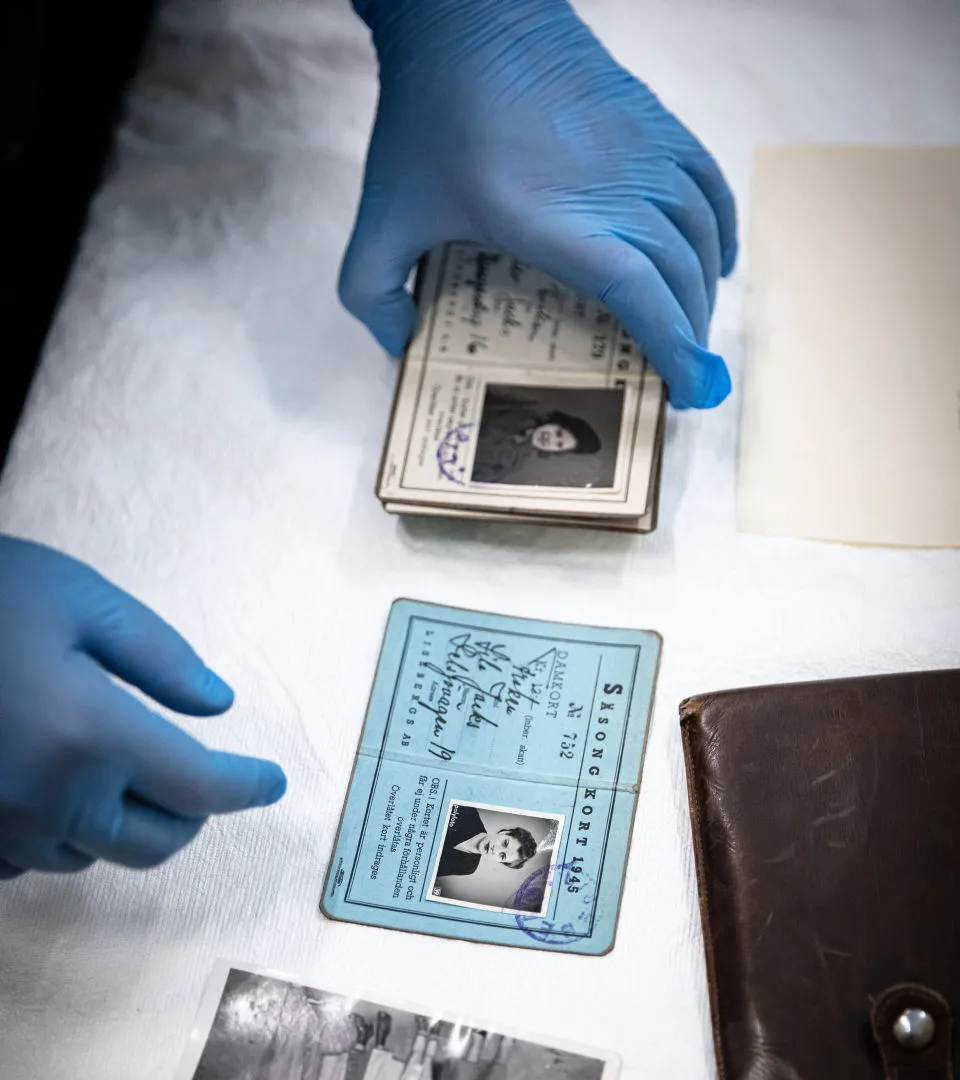
The Museum’s collections are an important resource for research and the development of knowledge across a range of academic disciplines. Objects, documents and personal testimonies can offer new perspectives on the Holocaust, its survivors and their descendants, and its significance for subsequent generations.
The Museum conducts its own research and development activities to deepen and broaden knowledge within its remit. This work also involves collaboration with researchers, universities, higher education institutions and other knowledge organisations, both in Sweden and internationally. Through partnerships, research seminars and workshops, the Museum aims to foster the exchange of knowledge and contribute to ongoing research into the Holocaust and its relevance today.
More information about research collaborations and opportunities for cooperation is available on the For researchers page.
Ongoing and completed research and development projects
Project time: 2022–2025 (2026)
The project examines ethical and sustainable practices for collecting, curating, and making Holocaust-related materials accessible to the public and researchers. It addresses ethical challenges tied to collecting methods, difficult heritage, politics, and identity.
The interdisciplinary approach bridges the gap between academic researchers and museums, fostering shared perspectives and expertise. The aim is to strengthen ethical competence in Holocaust collection by:
- Deepening ethical understanding in Holocaust research and collecting practices through interdisciplinary collaboration
- Exploring diverse perspectives on the materiality of Holocaust-related Museum collections
- Developing practical guidelines for ethical collection and curation.
Key outcomes include an academic anthology, a better practices report, and an international conference.
Project manager and contact person: Britta Z. Geschwind (The Swedish Holocaust Museum).
Other participants and Co-researchers:
Prof. Markus Idvall (Stockholm University),
Prof. Fredrik Nilsson (Åbo Akademi University),
Prof. Liv Nilsson Stutz (Linnaeus University)
Prof. Malin Thor Tureby (Malmö University).
The network also brings together cultural heritage institutions in Sweden with Holocaust-related collections, including the Helsingborg Museum, Hälsingland Museum, Kulturen in Lund, Lund University Library, Malmö City Archives, the Nordic Museum, and the Swedish Holocaust Museum.
Funding: The Swedish Research Council
Project period: 2024–2029
In recent years, Holocaust research has turned more toward the personal stories of survivors, especially looking at how they remember, cope, and show resilience.
This project focuses on the experiences of Polish Jewish women who survived the Holocaust and later settled in Sweden. The study focuses on their individual stories – how they dealt with displacement, survival, and rebuilding their lives. It also examines the objects they kept, such as personal items and museum artifacts, to understand how memories are preserved and passed on. Through an intersectional perspective, the project explores how factors like gender and background shaped these women’s memories and experiences. Combining personal testimonies with historical and museum sources, this research will shed new light on how Holocaust memory is shaped, shared, and remembered today.
Project leader and contact person: Matylda Jonas-Kowalik, PhD student, Uppsala University in collaboration with the Swedish Historical Museums. (matylda.jonas-kowalik@shm.se)
Funding: Uppsala Center for Holocaust and Genocide Studies and Statens Historiska Museer/Swedish Holocaust Museum (PhD project)
Project duration: 2025–2027
Over forty Swedish museums have Holocaust-related materials in their collections. Internationally, Holocaust-related materials are often described as fragmented, in the sense that items with connections to each other belong to different museums and archives, often in different countries. This is also the case for Swedish collections. In this project, we are developing controlled and well-defined vocabularies for Holocaust-related materials in Swedish and English, which will be made available as linked open data. With the help of the vocabularies, Swedish museums will be able to digitalize their Holocaust-related materials so that they become more harmonized, accessible and searchable, as well as linked to international collections. In the long run, this will benefit learning, research and knowledge dissemination about the Holocaust.
Participators (all at the National Historical Museums): Lotta Fernstål, researcher and project manager, Elin Fornander, researcher, Yael Fried, senior curator Swedish Holocaust Museum, Klara Gustafsson, curator digitalization, Elin Eriksson, collections systems manager
Project manager and contact person: Lotta Fernstål, National Historical Museums of Sweden, lotta.fernstal@shm.se
Funding: The Conference on Jewish Material Claims Against Germany, with co-funding from the National Historical Museums of Sweden.
Report in Swedish from the project’s preliminary study: Förintelserelaterade material i museisamlingar. Digitaliseringsbehov och forskningsperspektiv
Project Duration: 2025–2027
The newly opened Swedish Holocaust Museum has a national mission to be relevant to the entire nation. A frequently asked question from the public is why Sweden, a then neutral country without killing sites, should have a Holocaust Museum? The project is responding to this question by mapping and investigating reception camps for Nazi concentration camp survivors, “repatriates”, transferred to Sweden in 1945. There were hundreds of camps from south to north. Some survivors stayed and became citizens. Others, too weak to survive, rest in Swedish cemeteries. Many also choose to leave the country or were forced to. Their presence has left behind both material and immaterial traces.
The aims are to 1.) map and explore traces of the repatriate camps in the landscape, their historiography, as well as present-day memory practices. What, and whose stories, linger? In what ways? The project problematizes borders of divisions, such as Jewish/non-Jewish survivors, newcomers/locals, men/women, adults/children. The aim is also to 2.) provide research-based knowledge and support for the task of expanding the collections of the SHM. And 3) to disseminate this knowledge to the public in the form of a digital map, exhibitions, and academically in open-access articles, aiming to contribute internationally with knowledge on reception practices, sorting, relations, and survivors´ movements.
Project manager and contact person: Natalia Krzyzanowska
Funder: Riksbankens Jubileumsfond, RJ Flexit