The White Boats – a Swedish humanitarian operation
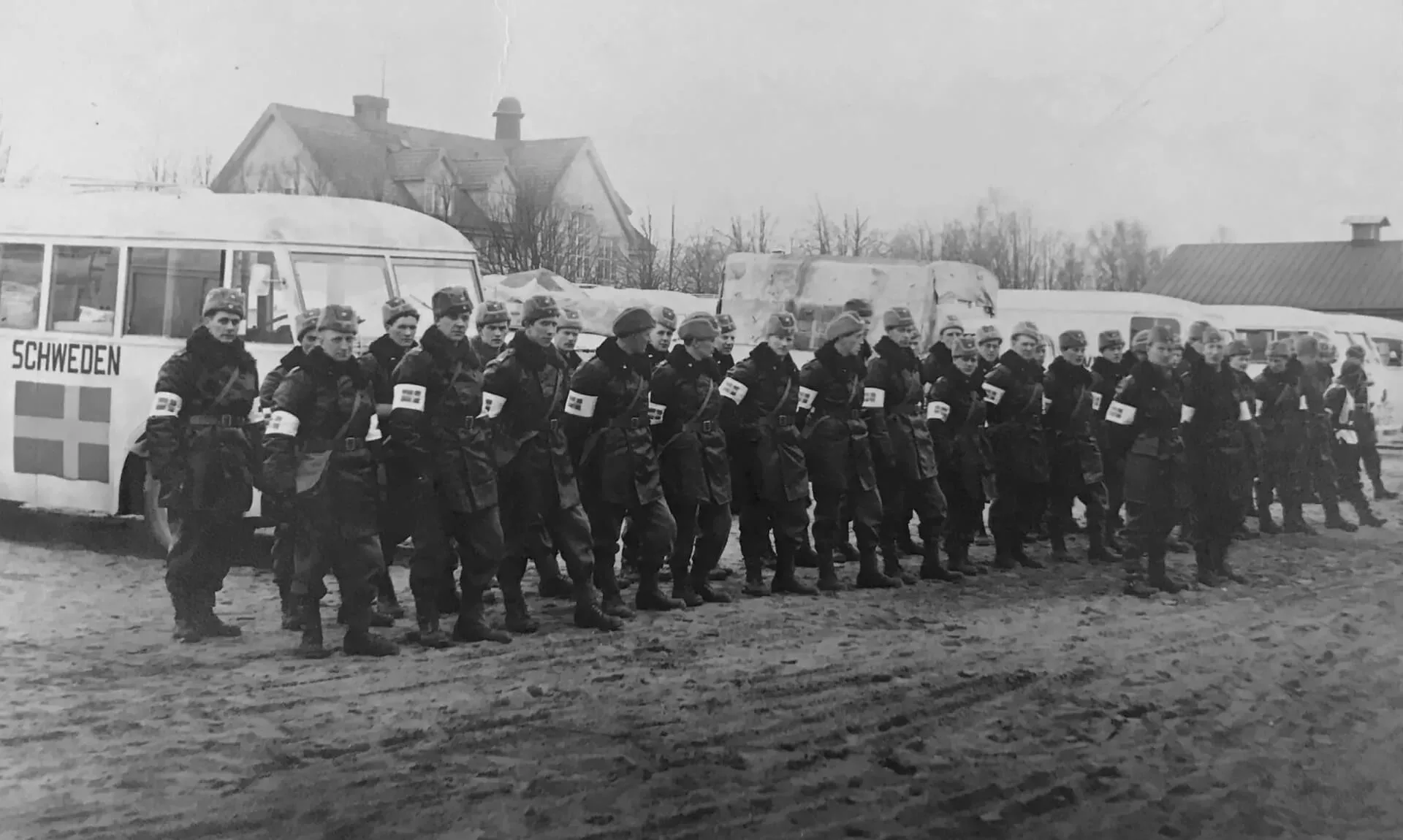
As the Second World War ended, Sweden carried out several rescue and evacuation operations to help people who had survived the Nazi concentration camps. The best known was the Swedish Red Cross operation involving the so-called White Buses, led by Folke Bernadotte. Between March and May 1945, thousands of prisoners were rescued from Nazi camps, including many Jews.
Shortly after the rescue operation involving the White Buses had ended, the Allied refugee organisation United Nations Relief and Rehabilitation Administration (UNRRA) asked Sweden to receive more survivors from the concentration camps. Sweden agreed to accept a maximum of 10,000 former concentration camp prisoners and eventually received around 9,000 people.
The difference between the White Buses and the White Boats was that the rescue operation involving the buses took place while the war was still ongoing, with negotiations and agreements made with Nazi Germany. The White Boats, by contrast, were part of a humanitarian operation for concentration camp prisoners who had already been liberated. They were brought to Sweden for medical care and recovery before returning to their home countries, at least according to the original plan.
In Europe, these people were known as Displaced Persons (DPs). Swedish authorities referred to them at the time as repatriands, as they were expected to return to their home countries. Jewish communities later came to refer to them as ‘the rescued of 1945’.

Bergen-Belsen and the survivors
Most of the people who later came to Sweden had been liberated from Bergen-Belsen concentration camp in northern Germany. When British troops liberated the camp on 15 April 1945, around 60,000 prisoners were still there, along with nearly 13,000 unburied bodies lying in heaps across the camp grounds.
During the final stages of the war, the Nazis had transferred prisoners to Bergen-Belsen from other camps, including Auschwitz. Railway lines had often been destroyed by bombing, so prisoners instead had to walk for days and sometimes weeks. These forced journeys are commonly known as death marches. The transfers were part of the Nazis’ attempts to remove traces of the Holocaust. By gathering prisoners in one place, they could also leave them to die from diseases such as typhus and dysentery. Nazi Germany chose to hand Bergen-Belsen over to the British, apparently to avoid having to deal with the problems posed by the camp.

Conditions in Bergen-Belsen were appalling. In the final weeks before liberation, many prisoners had little or no food or water. Diseases spread rapidly, and many people died. Those who survived were often so seriously ill and malnourished that they had to be carried out on stretchers. The British soldiers, the first Allied troops to arrive at the camp, gave some of the starving prisoners food from their own rations. This food was high in fat and intended for soldiers. As a result, around 2,000 sick and starving prisoners in Bergen-Belsen died because their bodies could not process the rich food. After the liberation, a large reception camp was established near Bergen-Belsen for tens of thousands of survivors.
Sweden’s operation in Lübeck
Co-operation between UNRRA and Sweden was not a foregone conclusion. Sweden’s neutrality during the war made some Allied representatives hesitant about working with the country. There was also uncertainty about whether the survivors themselves wanted to travel to Sweden.
Despite these concerns, an extensive international humanitarian operation was developed. The Swedish Red Cross, the Swedish National Board of Health, the Swedish Civil Defence Board, UNRRA, SHAEF and the British 21st Army Group worked together to carry out the evacuations. Former concentration camp prisoners were collected from various camps in Germany and taken to Lübeck for onward transport.
To reduce the risk of infectious diseases entering Sweden, it was decided that a medical inspection station should be established in Lübeck. The Swedish Transit Hospital was set up at Cambrai Barracks, along with a special Lübeck detachment led by the doctor Hans Arnoldsson, who had previously taken part in the White Buses operation. The detachment prepared the former prisoners for their journey to Sweden.

The White Boats
The transports to Sweden were carried out using five ships: Karskär, Rönnskär, Kastelholm, Prins Carl and Kronprinsessan Ingrid. The last three were painted white, which is why the operation is sometimes referred to as the White Boats or the White Ships.
Between the summer and autumn of 1945, more than 9,000 survivors were transported to Sweden. They came mainly from Poland, Hungary, Czechoslovakia and Romania, but in total they represented around 20 different nationalities. Most were young adults who had survived the concentration camps.

Reception in Sweden
Preparations were made in Sweden to receive the survivors by opening a number of emergency hospitals and other medical facilities. Most arrived at ports in southern Sweden, including Malmö, Landskrona, Kalmar and Gothenburg. Some transports also went to Stockholm and Norrköping.
However, several of the new arrivals were so seriously ill that they could not survive a further journey. They were admitted to the nearest hospital. The remaining arrivals were distributed among various camps, hospitals and sanatoriums around Sweden. Several of these facilities had been opened specifically to care for the former concentration camp prisoners who arrived.

Despite the care they received, many were seriously affected by their experiences. In the years that followed, several hundred Holocaust survivors died in Sweden from illnesses and injuries sustained during their imprisonment. Jewish burial grounds around Sweden still bear traces of those who did not survive for long after the Holocaust.
Staying or moving on
Researchers generally estimate that around half of those who arrived on the White Boats stayed in Sweden. Several spent a few months or years in the country before moving on. A small number returned to their home countries, but many of those who left Sweden later moved elsewhere, most often to the United States or to Israel, which was established in 1948. The establishment of Israel provided a place of safety for many Jews in the aftermath of the Holocaust.
During the 1950s, many of the survivors became Swedish citizens. Several women married Swedish men and thereby acquired Swedish citizenship. Others were able to apply for citizenship. Following an amendment to the citizenship law, applying became easier, particularly for refugees and stateless people. The process took place step by step, and each person had to apply individually. It could take up to ten years, depending on their circumstances and how quickly their application could be processed.
For many, Sweden became a temporary refuge. Others stayed for the rest of their lives and became part of Swedish society. Their stories help keep the memory of the Holocaust alive. Traces of those who did not survive can still be found in burial grounds and memorial sites throughout the country.
One project that documents these individual life stories is Förlorade Röster (Lost Voices). You can read more about the project on our website.
The museum's collection
Do you have a story or an object connected to the White Boats? Would you like to share it with the museum?
Email: samlingar@museumforintelsen.se
You can also read more about the museum's collection connected to the White Boats: